3 family members burnt to death in Benue


The Benue Police Command has confirmed deaths of three members of a family as a result of fire disaster in Otukpo, Otukpo Local Government Area of the state.

The Police Public Relations Officer (PPRO), DSP Sewuese Anene, made the confirmation on Friday in Makurdi.

An eyewitness who spoke on condition of anonymity to the News Agency of Nigeria (NAN) said the accident occurred in a two-bedroom flat of Jesus College Quarters, home of the father of the victims, Mr Ochoche Ode, at around 1.00am.

According to Ode, the fire was noticed midnight on Friday by his wife’s younger sister who perceived the smell that something was burning while three of his kids were asleep.

He said that he was in one of the rooms with his wife when they were alerted of the incident.

“As I was about going to find out what was happening, the fire surged covering the whole room where my kids were sleeping and in an attempt to force myself into the room to rescue the children; my face got badly burnt.

“All attempts by neighbours to quell the fire failed and all my three children were burnt to death,” Ode said.

The cause of the fire outbreak was yet to be known at the time of filing this report.

make up a story” means. to create a story that is not true. Example Sentences: You can’t believe anything he says. He is always making up stories.

Makeup to creat and give a good look to someone,make them look different and cute ,

Makeup is a wonderful and amazing thing to women gives good image of a person 😊😊

Canada lifts travel ban on Nigeria, nine other African countries

Canada announced Friday the lifting of a ban on foreign travellers from Nigeria and nine other African countries.

The country also reimposed testing, warning that the Omicron variant of Covid-19 risks quickly overwhelming hospitals.

Apart from Nigeria, the travel restriction on flights is also lifted on South Africa, Mozambique, Botswana, Zimbabwe, Lesotho, Eswatini, Namibia, Malawi and Egypt.

Health Minister Jean-Yves Duclos was quoted as announcing this at a news conference on Friday.

He said the lifting of the travel ban would take effect from 11:59 pm on Saturday.

The restriction had been announced last month “to slow the arrival of Omicron in Canada and buy us some time,” he said. 

“But with Omicron now spreading within Canada it is no longer needed,” he a

Pre-arrival negative PCR tests for all travelers would also be reinstated as of December 21, Duclos said, while repeating a government warning earlier this week that “now is not the time to travel.”

Officials said laboratory tests have confirmed as of Friday nearly 350 cases of the Omicron variant across Canada.

The total average daily Covid case count, meanwhile, has jumped by 45 percent in the past week to about 5,000.

“It is expected the sheer number of (Omicron) cases could inundate the health system in a very short period of time,” said Chief Public Health Officer Theresa Tam.

Nigeria records 1,424 new COVID-19 cases in 14 states, FCT


Nigeria on Wednesday recorded 1, 424 new COVID-19 infections in 14 states of the Federal Capital Territory (FCT).

The Nigeria Centre for Disease Control (NCDC) made this known on its Website on Thursday morning.

The NCDC said with the 1,424 new infections, Nigeria now has 220,000 COVID-19 cases.

It said that Lagos state topped the chart with 796, followed by Delta with 152 and the FCT with 130.

The NCDC said 153 cases were reported in Delta for Dec. 13 and 139 was recorded for Dec. 14.

The agency added that one person died of COVID-19 complications raising the country’s fatality toll to 2,983.

The centre said 3,686,403 tests have so far been conducted since the virus was announced on Feb. 27, 2020.

The NCDC noted that a multi-sectoral national emergency operations centre, activated at Level II, continues to coordinate the national response activities.

The News Agency of Nigeria (NAN) reports that Nigeria recorded 730 new cases of COVID-19 in 10 states and the Federal Capital Territory (FCT) on Tuesday.

Gunmen Abduct DSS Officer, Kill Vigilante Member In Abuja


Gunmen have abducted a Department of State Services operative during an attack on residents in Abaji, Abaji Area Council of the Federal Capital Territory, Abuja, on Saturday.

The hoodlums also killed a vigilante member during the incident which occurred overnight, PUNCH reports.

The armed men were said to have invaded the community in their numbers and attacked a DSS outpost in the area.

During the exchange of gunshots with the DSS operatives, the gunmen successfully kidnapped an operative.

The FCT police spokesperson, Josephine Adeh, said she did not have information on the incident and referred inquiries to the DSS.

But spokesperson for the secret police, Peter Afunanya, had yet to respond to inquiries as of the time of filing this report.
DSS DENIES REPORT OF ABDUCtION OF PERSONNEL in ABUJA

The Department of the State Services (DSS) has refuted a report that bandits in Abaji council area of the Federal Capital Territory abducted some of its operatives. 

A media report had said gunmen suspected to be bandits had stormed a community in the council in the wee hours of yesterday and abducted an unspecified number of DSS operatives. 

The report, quoting eyewitnesses, said gunmen besieged the locality and shot sporadically for hours leaving one vigilante operative dead and an unknown number of operatives of the secret police whisked away. 

But DSS spokesperson, Peter Afunanya, in a terse response, described the report as false, saying that “No DSS personnel was abducted in Abaji or anywhere in the FCT.” 

Abaji, located along the Abuja-Lokoja expressway, is notorious for series of crimes, including highway robbery and abduction of travellers.

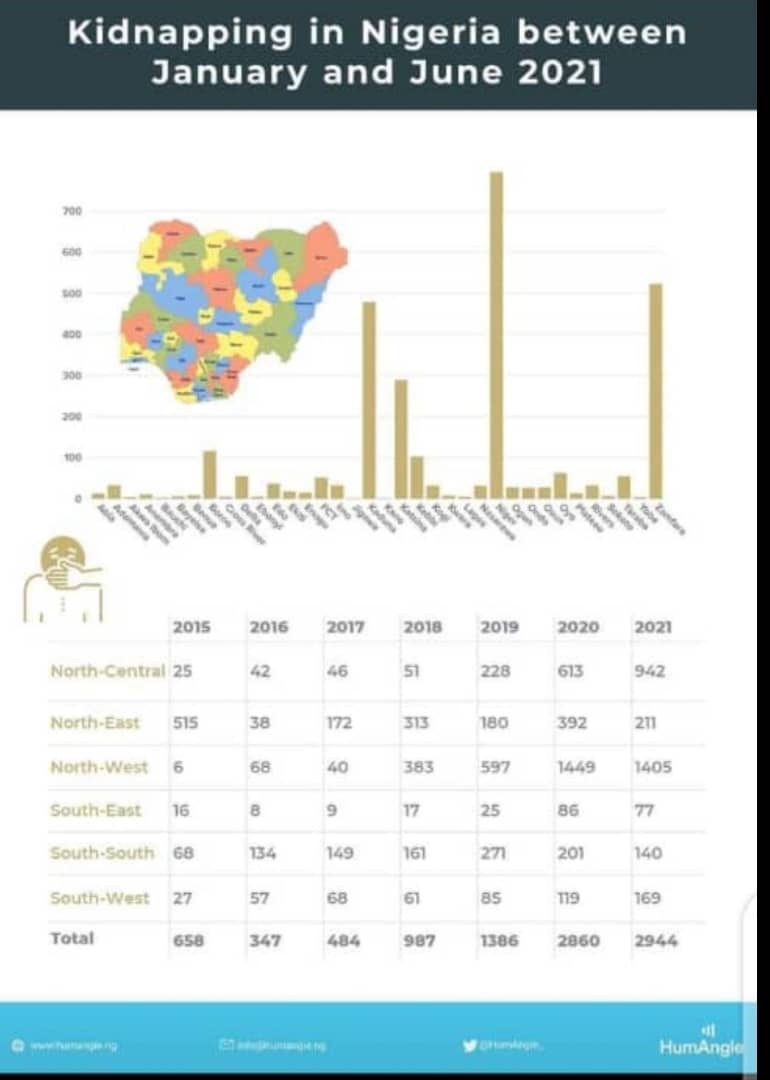
The rate of kidnapping in Nigeria has more than doubled so far in 2021 compared to previous years, available data has shown.By analysing data collected through the Nigeria Security Tracker (NST) between 2015 and June 2021, HumAngle observed a growing trend in the number of mass abductions as well as the total number of people who are victims of kidnapping in the country.While in 2017, there were 484 kidnapping victims, the figure grew to 987 the following year, then 1,386 in 2019, and 2,860 in 2020.Between Jan. 1 and June 30, this year, at least 2,944 people have already been reported kidnapped — making 2021 the worst year yet based on this security index. These numbers are higher if communities along the border areas in Cameroon, Chad, and the Niger Republic are taken into account.The number of kidnapping incidents has increased too, from 110 in 2015 to 135 in 2016, 140 in 2017, 156 in 2018, 330 in 2019, 437 in 2020, and then 315 in the first half of 2021.Another worrisome trend is the increase in the number of mass abductions. The average number of victims per incident has increased over the years from 2.6 in 2016 to 9.4 this year. While there were five abductions in 2015 with over 20 victims, Nigeria recorded 11 of such cases in 2018, eight in 2019, 25 in 2020, and 31 within the first six months of 2021.Young people, especially those enrolled in school, are some of the commonest targets of these large-scale atrocities. This year alone, students have been kidnapped in their tens and hundreds in Kagara, Niger State; Jangebe in Zamfara State; Afaka in Kaduna State; and Yauri in Kebbi State.A tally done by This Day Newspaper estimates that, as of March, over 618 schools had been closed in Northern Nigeria due to the frequent attacks and abduction of students. The affected states included Sokoto, Zamfara, Kano, Katsina, Niger, and Yobe.The numbers from NST also show how the wave of kidnapping has shifted from one region to the other.Back in 2015, the Northeast and South-south had the highest numbers of victims as a result of the Boko Haram insurgency in the former and acts of militancy in the latter. But, a few years down the line, especially in 2020 and 2021, the North-central and Northwest have now become the hardest-hit regions due to spreading terrorism and banditry.This year, states in the Northwest had 1405 victims of kidnapping, followed by the North-central region (942), then Northeast (211), Southwest (169), South-south (140), and Southeast (77).Growing insecurity in Nigeria has been attributed to alarming unemployment rates, the smuggling and circulation of small arms, as well as the understaffing and underequipping of security forces.In a report published last year, research group SBM Intelligence described the problem as the “democratisation of the kidnap industry,” estimating that, between 2011 and 2020, at least $18.34 million was paid as ransom to kidnappers in the country.In a statement released on Sunday, June 11, Nigerian President Muhammadu Buhari urged the military to “respond to the worrying situation in a language that the bandits understand.” He added that the security agencies were working on new methods and policies that had started to yield positive results in the troubled regions. Available data, however, appears to disagree with this

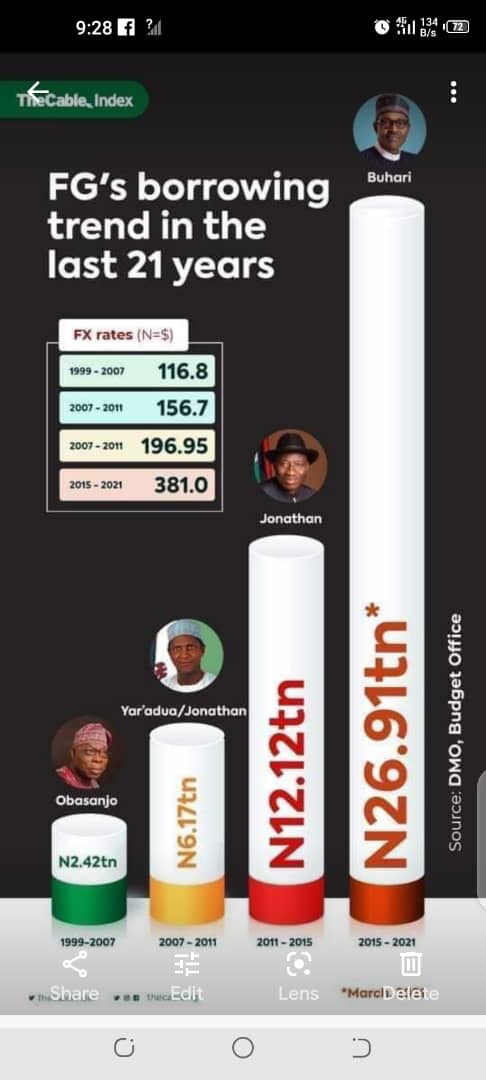
OLUSEGUN OBASANJO’S TENUREDuring the tenure of former president Olusegun Obasanjo, the debt level of the federal government reduced from N3.55 trillion in 1999 to N2.42 trillion at the end of 2007.The 8-year term of Obasanjo resulted in a dip in FG’s local and foreign debt level, representing a 31.8 percent decline.The country’s exchange rate was between N98.02 to N116.8 to a dollar during the tenure.Analysis of the figures showed that external debt decreased from $28.04 billion by 1999 to $2.11 billion at the end of 2007. However, the domestic component increased from N798 billion to N2.17 trillion within the same period.The huge decline in foreign debt was a result of the substantial reduction following the pay-off of the outstanding debts owed to the London Clubs of Creditors in the first quarter of 2007.YAR’ADUA/JONATHAN’S TENUREUnder the Umar Musa Yar’Adua/Goodluck Jonathan-led government between 2007 and 2011, domestic debt of the federal government moved from N2.17 trillion to N5.62 trillion. The foreign component of the debt also increased from $2.11 billion to $3.5 billion within the period.The country’s exchange rate also moved from N116.8/$1 to N156.7/$1.The combined debt profile increased from N2.42 trillion to N6.17 trillion in four years, representing a 155 percent jump.Of the debt figure, Jonathan completed the tenure from May 2010 to May 2011 after the death of Yar’Adua. The period saw a surge in the federal government’s debt from N4.94 trillion to N6.17 trillion. This represents a 24.9 percent increase in one year.GOODLUCK JONATHAN’S TENUREAt the beginning of former President Goodluck Jonathan’s tenure in 2011, the federal government had an accumulated debt of N6.17 trillion.Analysis of the debt figure showed that local debt amounted to N5.62 trillion while foreign debt stood at $3.5 billion (about N548.65 billion, using the exchange rate of N156.7/$1).By the end of 2015, the foreign debt component hit $7.3 billion, while domestic debt increased by N8.4 trillion. The country’s exchange rate also stood at N197/$1.Overall, the federal government component of the total public debt increased from N6.17 trillion in 2011 to N9.8 trillion in 2015, representing an increase of N3.63 trillion or 58.8 percentBUHARI’S TENUREThe Budget Office’s medium-term expenditure framework and fiscal strategy paper from 2015 showed that the Buhari-led administration incurred N7.63 trillion in domestic debt from June 2015 to December 2020.On external borrowings, President Buhari increased debt from $7.3 billion in 2015 to $28.57 billion as of December 2020. This means that the president incurred $21.27 billion on foreign loans to the country’s debt portfolio.The country’s exchange rate moved from N197 to a dollar in 2015 to N381 at the end of December 2020.Analysis of consolidated debt showed that the external debt increased by 291.37 percent while domestic debt grew by 86.31 percent in the last six years of the Buhari government.Overall, the Buhari-led government has had an accumulated debt of N17.06 trillion as of March 2021, using the N381 exchange rate. This represents a 173.2 percent increase from when he was elected president in 2015.

Over 2,371 persons were abducted by SBM intelligence has said According to the report, an average of 13 persons were abducted  daily within the period across the 36 states of the federation and the federal capital territory . The kidnapping rate was at level of 0.3 cases 100,000 population in 2013, down from 0.4 cases per 100,000 population previous year, this is a change of 6.96% An average of 13 persons were abducted daily in Nigeria in the first half of 2021 ,according to 2,371 the number of person  kidnapped in the country within the first six month of the year. Sent from my iPhone

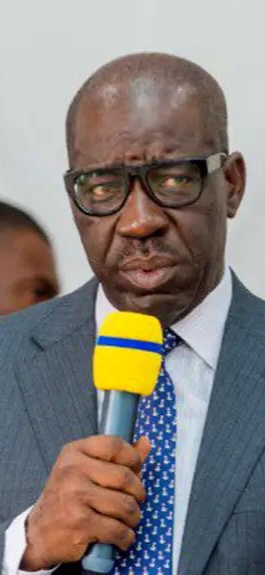
Governor Godwin Obaseki of Edo state has hailed the selfless sacrifices made by officers and men of the Armed Forces to keep Nigeria one and said the country would not be divided. Obaseki stated this on Thursday in Benin at the launching of the 2022 Armed Forces Remembrance Day Emblem. According to him, most Nigerians have benefited from the selfless sacrifices of members of the armed forces “from the first world War through our civil war till this day, where we are still losing patriots”. He said that it was imperative to remember and appreciate the fallen heroes and the enormous courage of serving gallant soldiers. “As a state and a country, we remain very optimistic that despite the threats of insecurity and banditry which we face as a country and a state, that we will overcome. “We are hopeful that we will continue to secure our state and our country, because we have courageous people like you, who are ready to serve and sacrifice for the country. “That is why we take event like this very seriously and to encourage the younger ones what sacrifices to the country means and also to encourage those of you who are in service that your efforts will not be in vain. “This occasion also reminds us of the need to jealousy guard the unity of our country. “We should not encourage the kind of rhetoric that we have been parading in this country today about the unity of our great country. Nigeria has come to stay, and Nigeria cannot and will not be divided. “It has to be so, because people have paid a supreme sacrifice to keep this country together, and it will not be right or fair to do anything to make it look as if those people who fought for this country did not know what they were doing.” The governor launched the Emblem with N10 million, pledged to replace the legion’s Hilux van and include the legion as part of the state’s security architecture. “We need your services, we need people like you to help us improve the work being done by our local vigilantes across the various ward and local governments,’’ Obaseki said. In his comments, the Speaker, Edo House of Assembly, Mr Marcus Onobun pledged 50 per cent of his salary to the legion while the state Chairman of the Peoples Democratic Party, Mr Tony Aziegbemi, donated N1 million. In his remarks, the state Chairman of the Nigerian Legion, Mr Ignatius Enabulele, pledged their support to tackle insecurity in the state.

Design a site like this with WordPress.com
Get started